.png)
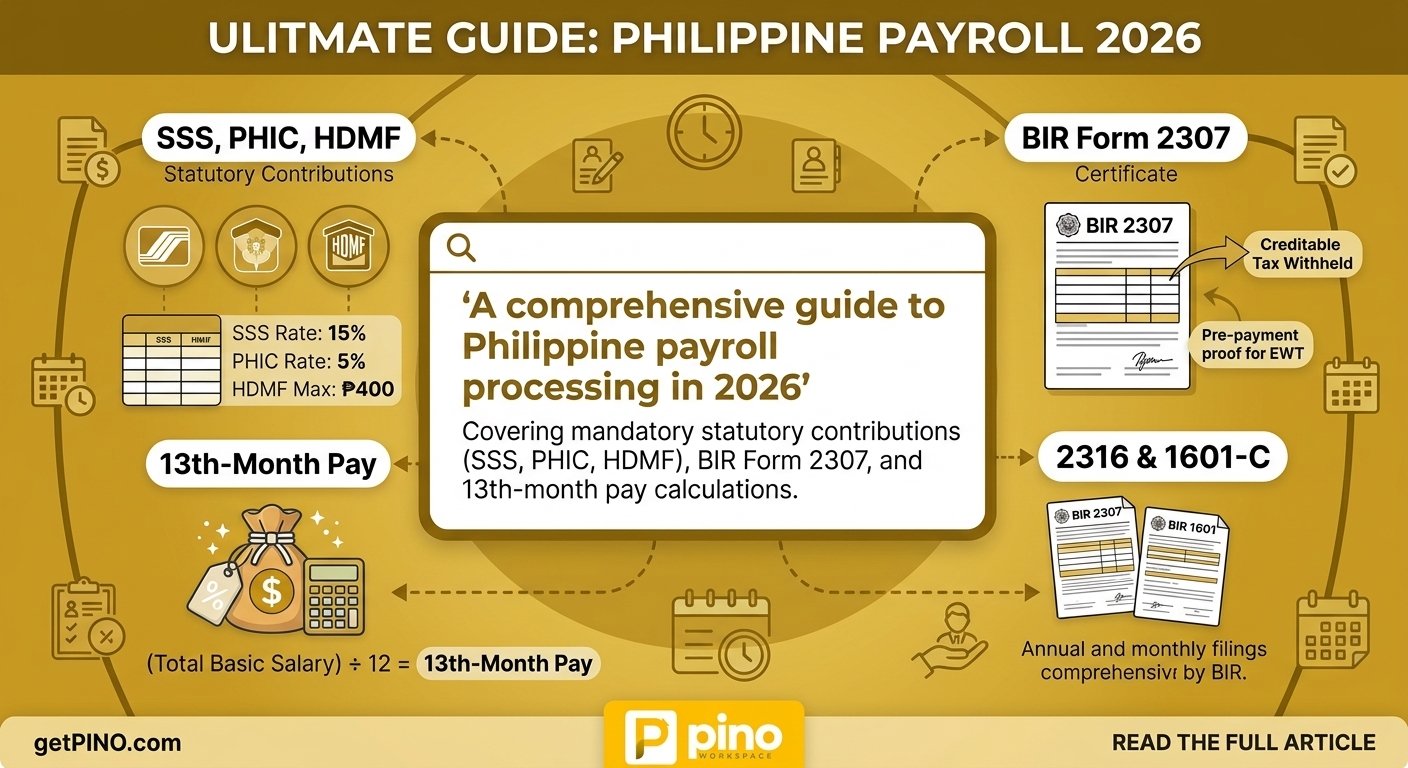
Managing payroll in the Philippines is uniquely complex. Between shifting statutory contribution tables, mandated expanded withholding taxes, BIR compliance, and multi-tier overtime rules, manual spreadsheet calculations quickly become a liability for growing companies and BPOs.
Whether you are managing a 5-person agency or a multi-location enterprise, maintaining audit-ready payroll and tax compliance is non-negotiable. Here is a breakdown of the core requirements every Philippine employer must manage seamlessly in 2026.
1. Statutory Contributions Breakdown (SSS, PhilHealth, Pag-IBIG)
Employers are legally required to deduct and remit monthly statutory contributions on behalf of their regular, probationary, and contractual workforce.
- Social Security System (SSS): Calculated using the latest SSS Regular and Mandatory Provident Fund (MPF) Contribution Schedule. Employers cover the larger share of the total contribution based on the employee's Monthly Salary Credit (MSC).
- PhilHealth (PHIC): Computed based on the current premium rate capped at maximum income thresholds. Contributions are split evenly ($50/50$) between the employee and the employer.
- Pag-IBIG Fund (HDMF): Deducted based on the mandatory ceiling rates for both employee and employer shares, with options for voluntary top-ups under MP2 accounts.
2. BIR Withholding Tax & Form 2307 / 2316 Processing
Tax compliance goes beyond monthly salary deductions. Managing contractor retainers and year-end annualization requires accurate documentation:
- BIR Form 2316 (Certificate of Compensation Payment/Tax Withheld): Issued annually to employees to certify taxable wages and personal income tax withheld across the calendar year.
- BIR Form 2307 (Certificate of Creditable Tax Withheld at Source): Crucial for businesses working with independent contractors, consultants, and corporate vendors under Expanded Withholding Tax (EWT) provisions.
Pro Tip: Delays or errors in issuing BIR 2307 forms to your vendor network can result in tax filing disallowances and costly BIR administrative penalties.
3. Automated DTR, Overtime, and Night Differential Rules
Manual daily time record (DTR) tracking is where most payroll errors originate. Under the Philippine Labor Code, standard payroll processing must account for:
- Regular Overtime (125% of hourly rate)
- Rest Day & Special Non-Working Holiday Work (130% of hourly rate)
- Regular Holiday Work (200% of hourly rate)
- Night Shift Differential (110% of base rate for hours worked between 10:00 PM and 6:00 AM)
4. Modernizing Your Operations with Automated Systems
Relying on legacy spreadsheets for timekeeping and tax withholding exposes your organization to human error, compliance risk, and wasted administrative hours.
Modern platforms like Pino Workspace streamline the entire workflow—automatically fetching DTR entries, applying exact statutory contribution schedules, generating 1-click BIR tax forms, and releasing digital payslips directly to your team.
Ready to Streamline Your Philippine Operations?
Stop spending days processing payroll manually every cut-off. Book a live demo with Pino Workspace today to see our automated HRIS, Payroll, and Invoicing modules in action.